
What Can Your Feet Tell You About Your Health?
A Western and Chinese Medicine Perspective
Most of us don't pay very much attention to our feet.
We put on our shoes, get on with the day, and perhaps only really notice our feet when they hurt.
But sometimes they change.
They become unusually cold. They swell. They feel hot, numb or tingly. The skin becomes dry or cracked. The colour changes. A toenail becomes thickened. A bunion gradually develops. Or perhaps there's a wound that simply doesn't seem to heal.
Can our feet actually tell us something about our health?
Sometimes — but they cannot diagnose what's happening inside the body.
Some changes have very ordinary explanations. Others can be associated with circulation, nerves, skin conditions, biomechanics, injury or wider medical conditions.
Traditional Chinese Medicine also pays considerable attention to the feet, although it interprets signs and symptoms through a very different framework.
So, what might be worth noticing?
1. Cold Feet
Everyone gets cold feet occasionally — particularly during an Icelandic winter!
But some people seem to have cold feet almost constantly, even when the rest of their body feels reasonably warm.
From a conventional medical perspective, persistently cold feet can have many explanations. Environmental temperature is an obvious one, but circulation, thyroid function, anaemia, neurological conditions and other health problems can sometimes contribute.
A Chinese medicine perspective
Chinese medicine wouldn't diagnose the cause simply because someone's feet are cold.
Instead, we might ask:
Are the hands cold too? Do you generally feel cold? Are you tired? What is your digestion like? Do you prefer warmth? How is your energy? What does your tongue look like? What does your pulse feel like?
Depending upon the complete presentation, cold extremities may form part of patterns involving Yang deficiency, Qi deficiency, Cold or impaired circulation of Qi and Blood.
The cold feet are one piece of information.
The wider pattern tells us much more.
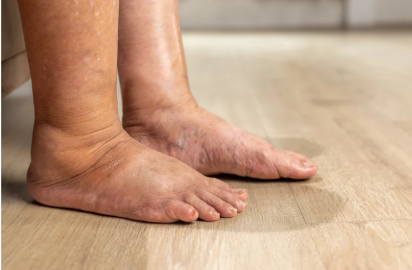
2. Swollen Feet and Ankles
Temporary swelling can occur after spending a long time standing or sitting, travelling, or being in hot weather.
Persistent or unexplained swelling is different.
Oedema of the feet and ankles can have numerous causes, including venous problems, medications and conditions affecting the heart, kidneys or liver.
Sudden swelling — particularly if one leg becomes swollen, painful, red or warm — warrants prompt medical assessment.
A Chinese medicine perspective
Chinese medicine traditionally considers how the body transforms, transports and distributes fluids.
Depending upon the complete presentation, swelling and heaviness may be discussed in terms of Dampness, Spleen Qi deficiency, Kidney Yang deficiency or impaired fluid transformation.
But this is an important distinction:
Swollen feet do not automatically mean “Dampness.”
We need the rest of the pattern.
3. Numbness and Tingling
Most of us have experienced pins and needles after sitting awkwardly or temporarily compressing a nerve.
But persistent or recurrent numbness and tingling deserves more attention.
It can occur for many reasons, including nerve compression, peripheral neuropathy, diabetes, vitamin deficiencies and other neurological or circulatory conditions.
New or persistent changes in sensation should therefore be appropriately medically assessed.
A Chinese medicine perspective
Traditional Chinese medicine may consider whether the tissues and channels are being adequately nourished by Blood and whether Qi and Blood are moving freely through the area.
Depending on the rest of the presentation, numbness might occur within patterns involving Blood deficiency, Blood stasis, Qi deficiency, Dampness or obstruction of the channels.
Again:
One symptom does not equal one TCM diagnosis.
4. Changes in Colour
Feet can temporarily change colour because of temperature, pressure and position.
But persistent or marked changes — particularly unusual paleness, redness, purple or bluish colour — deserve attention.
Changes in colour can sometimes relate to circulation, inflammation or other medical conditions.
A suddenly pale, blue, cold or very painful foot requires urgent medical assessment rather than trying to interpret it through Chinese medicine.
A Chinese medicine perspective
Colour is one of the many observations traditionally considered in Chinese diagnosis.
Broadly, paleness may appear alongside Cold or deficiency patterns, redness with Heat, and darker or purplish colour with stagnation or Blood stasis.
These are traditional pattern associations, however — not Western medical diagnoses.
5. Dry or Cracked Skin
Dry heels are extremely common.
Weather, footwear, ageing, frequent washing and simple lack of moisture can all contribute.
Persistent dryness and cracking can also occur with dermatological or other health conditions.
Deep cracks that become painful, bleed or show signs of infection deserve attention, particularly in someone with diabetes or impaired circulation.
A Chinese medicine perspective
Dryness may form part of a pattern involving insufficient Blood, Yin or body fluids, depending upon what else is happening.
For example, someone who experiences dryness alongside night heat and thirst presents very differently from someone who is pale, exhausted and generally depleted.
That distinction matters.
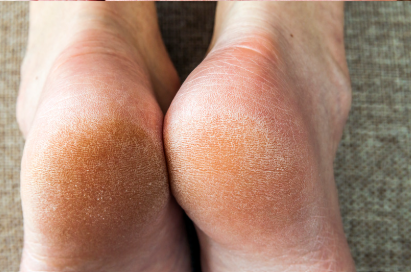
Cracked Skin
6. Hot or Burning Feet
Some people experience almost the opposite of cold feet.
Their feet feel unusually hot or even burning — sometimes particularly at night.
Persistent burning sensations can have neurological causes, including peripheral neuropathy, and unexplained burning should be medically assessed.
A Chinese medicine perspective
Heat in the feet can be an interesting sign within Chinese pattern differentiation.
Depending upon the accompanying symptoms, a practitioner might consider Heat, Yin deficiency or deficiency-Heat, particularly when there are other features such as night sweating, thirst, restlessness or disturbed sleep.
But saying:
“Burning feet = Yin deficiency”
would be far too simplistic.
The complete presentation still matters.
7. Wounds That Are Slow to Heal
This is one change I would never encourage somebody to interpret solely through Chinese medicine.
A cut, ulcer or sore on the foot that isn't healing normally can be associated with conditions including diabetes, impaired circulation and infection.
People with diabetes need to be particularly attentive to their feet because reduced sensation can sometimes mean that an injury isn't immediately noticed.
A persistent or worsening wound should be medically assessed.
Chinese medicine may have a supportive role in someone's broader healthcare where appropriate, but it should never delay proper wound assessment or treatment.
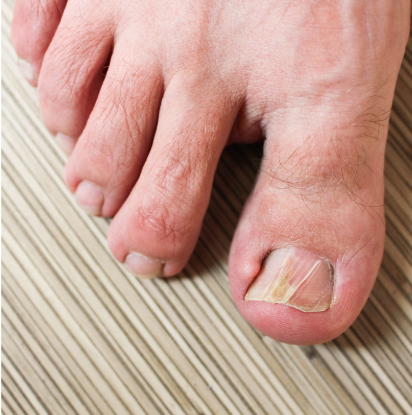
8. Changes in Your Toenails
Toenails naturally change with age and can also be affected by repeated trauma from footwear.
Thickened, brittle, yellow or discoloured nails are commonly associated with fungal infections, although other nail and skin conditions can look similar.
One nail change doesn't tell us what is happening throughout the body.
A Chinese medicine perspective
Traditionally, Chinese medicine considers the condition of the nails in relation to Blood and the Liver functional system.
However, this does not mean that a damaged or discoloured toenail indicates liver disease.
The Chinese medicine concept of the Liver is broader than the anatomical liver recognised in Western medicine.
The nails are simply another observation within the person's overall pattern.
9. Redness, Warmth and Pain
A red, hot and painful area of the foot can have numerous explanations — from injury and inflammation to gout or infection.
Sudden severe pain, significant swelling, rapidly spreading redness, fever or feeling generally unwell warrants medical attention.
A Chinese medicine perspective
Redness and warmth are traditionally associated with Heat, while pain and restricted movement may involve concepts such as obstruction or stagnation.
But simply describing a red, swollen joint as “Heat” is not sufficient clinical assessment.
TCM pattern differentiation and Western medical diagnosis are not interchangeable.
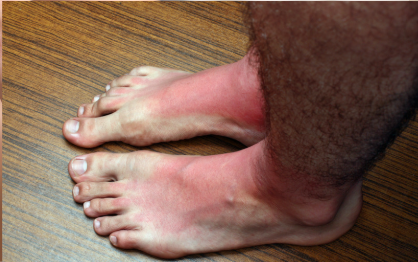
Red Skin
10. Corns and Calluses
Not everything we see on the feet reflects something happening internally.
Sometimes the explanation is much simpler.
Corns and calluses commonly develop in response to repeated pressure or friction.
Footwear, gait, activity and the structure of the foot can all contribute.
Persistent or painful problems may benefit from assessment by a podiatrist or another appropriate healthcare professional.
And this brings us to another very common change in the feet.
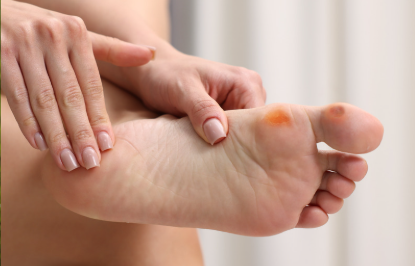
Corns and Calluses
11. Bunions — When the Structure of the Foot Changes
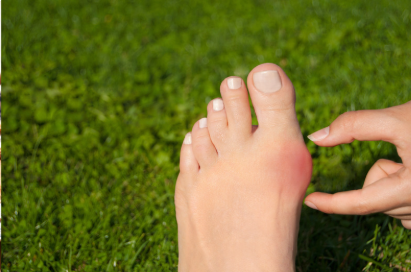
A bunion, medically known as hallux valgus, is a structural change involving the big toe and first metatarsophalangeal joint.
The big toe progressively deviates towards the other toes while the first metatarsal shifts in the opposite direction, producing the characteristic prominence on the inner side of the foot.
Unlike temporary swelling or temperature changes, a bunion is primarily a structural and biomechanical problem.
Genetic predisposition, foot anatomy and mechanics, and footwear can all contribute.
What about bunions in Chinese medicine?
This is where we need to distinguish traditional theory from anatomy.
Chinese medicine doesn't have a single traditional diagnosis that corresponds exactly to modern hallux valgus.
However, the location is interesting from a channel perspective.
The Liver and Spleen channels begin around the great toe and medial aspect of the foot, while other channels traverse different areas of the foot and ankle.
If a bunion is painful, a Chinese medicine practitioner may consider the local movement of Qi and Blood, channel obstruction, pain and inflammation alongside the person's broader pattern.
But a bunion does not mean that there is something wrong with your Liver or Spleen.
And acupuncture cannot physically straighten the bones of an established bunion.
Where acupuncture may potentially be considered is as an adjunctive approach to symptom management, such as pain and surrounding muscular tension, while structural and biomechanical management may involve appropriate footwear, load management, physiotherapy, podiatry or orthopaedic assessment.
This illustrates an important principle:
Sometimes a symptom forms part of a wider pattern. Sometimes the problem is primarily local and structural. Knowing the difference matters.
Why Are the Feet So Interesting in Chinese Medicine?
The feet occupy a particularly interesting place within Chinese medicine because several major acupuncture channels either begin or terminate there.
The Kidney channel begins on the sole of the foot.
The Liver and Spleen channels begin around the great toe and foot before travelling upwards.
The Stomach, Gallbladder and Bladder channels travel down the body and terminate around the feet and toes.
This does not mean that pain in a particular toe tells us that the corresponding internal organ is diseased.
That's an important distinction.
The Chinese medicine concept of an organ system or channel is not identical to the anatomical organ described by Western medicine.
Instead, the feet form part of the larger network through which Chinese medicine traditionally understands patterns and relationships within the body.
One Symptom Does Not Equal One Diagnosis
This may be the most important part of this entire discussion.
Social media makes health information very tempting to simplify:
Cold feet = poor circulation.
Swollen ankles = kidney problems.
Burning feet = Yin deficiency.
Purple feet = Blood stasis.
A bunion on the Liver channel = Liver problems.
Human bodies simply aren't that straightforward.
The same symptom can occur for completely different reasons.
Imagine two people who both tell me:
“My feet are always cold.”
One is generally cold, exhausted and pale and has poor appetite and low energy.
The other feels perfectly warm everywhere else but has suddenly noticed that one foot has become significantly colder than the other.
Those are very different clinical presentations.
The second requires consideration of a potentially important medical cause rather than simply being labelled a TCM Cold pattern.
This is one of the fundamental principles of Chinese medicine:
We don't simply treat an isolated sign. We look for the pattern surrounding it.
Your Feet and the Chinese Medicine Channels
There's another reason I think people find the feet fascinating.
The foot contains a remarkable concentration of acupuncture points.
KD1 (Yongquan) lies on the sole and is the first point of the Kidney channel.
The Liver and Spleen channels begin around the great toe.
The Stomach and Gallbladder channels terminate around the second and fourth toes respectively, while the Bladder channel reaches the little toe.
For a Chinese medicine practitioner, therefore, the feet are not simply something at the end of the legs.
They are part of a much larger channel system.
But again, we should resist turning that fascinating theory into oversimplified claims.
A painful big toe isn't automatically your Liver talking to you.
Sometimes it's tight shoes.
Sometimes it's a bunion.
Sometimes it's an injury.
Sometimes it's inflammation.
And sometimes a symptom deserves further medical investigation.
Good healthcare involves knowing the difference.
So, Should You Start Looking at Your Feet?
Perhaps you should.
Not because your feet contain a secret diagnostic map capable of revealing everything happening inside your body.
They don't.
But becoming familiar with your own body means you're more likely to notice when something changes.
Occasionally look at your skin and nails.
Notice persistent changes in temperature.
Pay attention to unexplained numbness, tingling or burning.
Notice unusual changes in colour.
Don't ignore wounds that aren't healing.
And pay attention when pain, swelling or structural changes begin interfering with the way you walk or live.
Most importantly, notice change from what is normal for you.
This connects beautifully with one of the longstanding ideas within Chinese medicine:
Observation.
We observe.
We ask questions.
We look at relationships.
We consider the whole person.
And rather than assuming that one symptom has one universal meaning, we ask:
What is the wider pattern?
Because sometimes your feet are simply tired.
Sometimes your shoes don't fit properly.
Sometimes the structure of the foot is changing.
And sometimes your feet are giving you a good reason to pay a little more attention to your health.
Medical note
This article is provided for general educational and wellbeing purposes and is not intended to diagnose, treat or exclude a medical condition. Traditional Chinese Medicine pattern descriptions are not equivalent to Western medical diagnoses. New, persistent, worsening or concerning changes in the feet — particularly non-healing wounds, sudden colour or temperature changes, significant one-sided swelling, severe pain, spreading redness or new persistent numbness — should be assessed by an appropriate healthcare professional.