
Does Qi Gong Really Do Anything? Understanding What Happens in the Body
Make it stand out
Whatever it is, the way you tell your story online can make all the difference.
Qi Gong can look almost too simple to be doing very much.
Slow movements.
Controlled breathing.
Standing quietly.
Gentle repetition.
Sometimes the movements are so subtle that people understandably wonder:
Does this actually do anything?
It is a fair question.
Qi Gong has been practised in China in various forms for centuries and today is used for health maintenance, movement, relaxation and mind-body practice.
But understanding why people practise Qi Gong requires looking at it from two perspectives.
There is the traditional Chinese Medicine understanding of Qi, movement, breath and Shen.
And there is the modern physiological understanding of breathing, movement, attention, stress regulation and the nervous system.
Interestingly, these two languages can sometimes describe different aspects of the same experience.
First, What Is Qi Gong?
The term Qi Gong (氣功) is made from two concepts.
Qi is usually translated as energy or vital energy, although that translation does not fully capture what the Chinese concept means.
Gong refers to skill or ability developed through consistent practice.
Qi Gong therefore refers broadly to practices designed to cultivate and regulate the body's functional activity through combinations of:
movement
posture
breathing
focused attention
relaxation
repetition
There are many different forms of Qi Gong.
Some are dynamic.
Some are almost completely still.
Some are traditionally associated with particular organs, channels or health concerns.
But most share one important principle:
The breath, body and mind are deliberately brought together.
But Are We Really "Energy"?
This is where conversations about Qi Gong can become confusing.
You will often hear statements such as:
"Everything is energy."
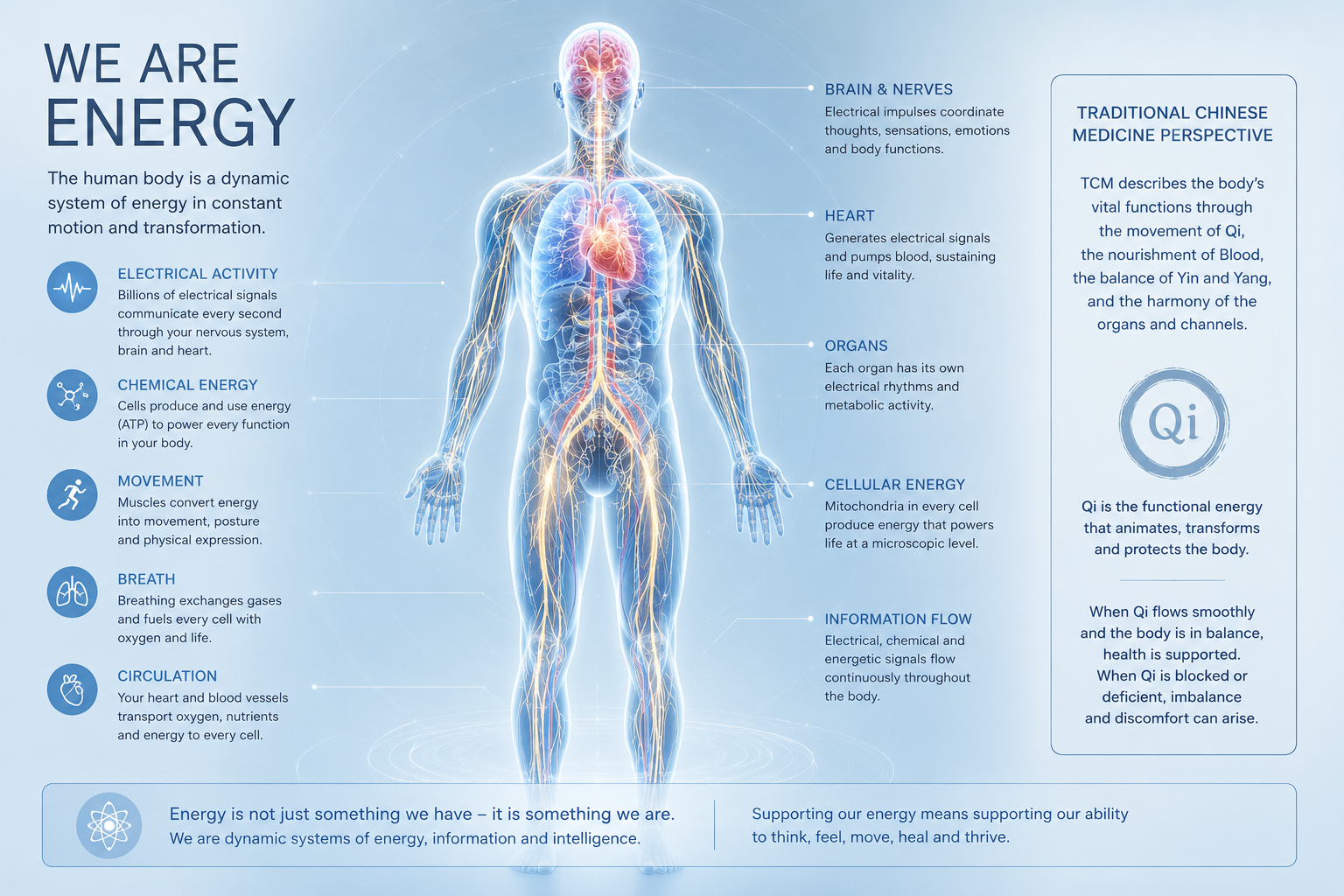
There is some truth behind the idea that the human body depends upon energy, but we need to distinguish modern physiology from traditional Chinese Medicine theory.
Your body is certainly not a static object.
At this very moment:
your heart is generating electrical activity.
Your nervous system is transmitting electrochemical signals.
Your muscles are converting chemical energy into movement.
Your cells are continuously producing and using ATP.
Your body is producing and exchanging heat.
Ions are moving across cell membranes.
Your lungs are exchanging gases.
Your cardiovascular system is transporting oxygen and nutrients.
Your metabolism is continually transforming matter and energy.
Even while you are sitting perfectly still, an extraordinary amount of biological activity is occurring.
So in a very literal physiological sense, life requires continuous energy transformation.
However, this does not mean that Qi is simply electricity, ATP or another measurable physical energy.
Qi belongs to the theoretical framework of Chinese Medicine.
Traditionally, Qi describes functional processes involving movement, transformation, warming, protection and physiological activity.
It is therefore more useful to understand Qi on its own terms rather than trying to force an exact equivalence between ancient Chinese medical theory and modern biomedicine.
What Does Chinese Medicine Say Qi Gong Is Doing?
Traditional Chinese Medicine views health as dynamic rather than static.
Qi should move.
Blood should circulate.
Fluids should be appropriately transformed and transported.
The organs and channels should function harmoniously.
And the Shen — broadly associated with the mind, consciousness and emotional state — should be settled.
From this perspective, Qi Gong is not simply about "getting more energy."
Sometimes a person doesn't need more stimulation.
They need better regulation.
Someone can be completely exhausted while simultaneously feeling:
restless
anxious
tense
unable to switch off
mentally overactive
unable to sleep
I often describe this as being wired but tired.
Trying to continually stimulate an already exhausted body isn't necessarily the answer.
Chinese Medicine may instead focus on restoring appropriate movement, nourishment, rest and regulation.
Qi Gong can form part of that process.
Why Are Qi Gong Movements So Slow?
This is one of the most interesting things about Qi Gong.
People accustomed to exercise being measured by intensity can look at Qi Gong and think:
How can moving this slowly possibly accomplish anything?
But intensity isn't the objective.
Slowing movement down changes the task.
You have to pay attention to:
your balance.
Your posture.
Your breathing.
Where you are holding tension.
How your weight shifts.
How your joints move.
What different areas of your body are doing.
You aren't simply completing a movement.
You are becoming aware of how you are completing it.
This combination of slow movement and attention is one reason Qi Gong sits somewhere between physical exercise, breathing practice and meditation.
The Breath Is an Important Part of the Practice
Breathing happens automatically.
But unlike many automatic processes, we can also consciously influence it.
That makes breathing particularly interesting.
Stress can change breathing.
Pain can change breathing.
Anxiety can change breathing.
Exhaustion can change breathing.
And breathing patterns can, in turn, influence how we feel.
Many Qi Gong practices encourage breathing that is:
slow, relaxed, quiet and coordinated with movement.
Rather than forcing enormous breaths, the aim is generally to allow breathing to become comfortable and natural.
This creates a very different physiological experience from rushing around all day while breathing rapidly and holding tension through the shoulders, chest and abdomen.
Qi Gong and the Nervous System
This is one of the areas where traditional practice becomes particularly interesting from a modern perspective.
Your autonomic nervous system continually helps regulate processes including:
heart rate
blood pressure
digestion
respiration
temperature regulation
stress responses
recovery
When we perceive threat or pressure, sympathetic activity helps prepare us to respond.
That response is necessary.
The problem is not that humans have a stress response.
The problem can arise when we spend too much time activated and too little time recovering.
Modern life can create almost continuous stimulation:
emails.
Phones.
Deadlines.
Work.
Family responsibilities.
Financial concerns.
Poor sleep.
Noise.
Information.
And very little genuine physiological downtime.
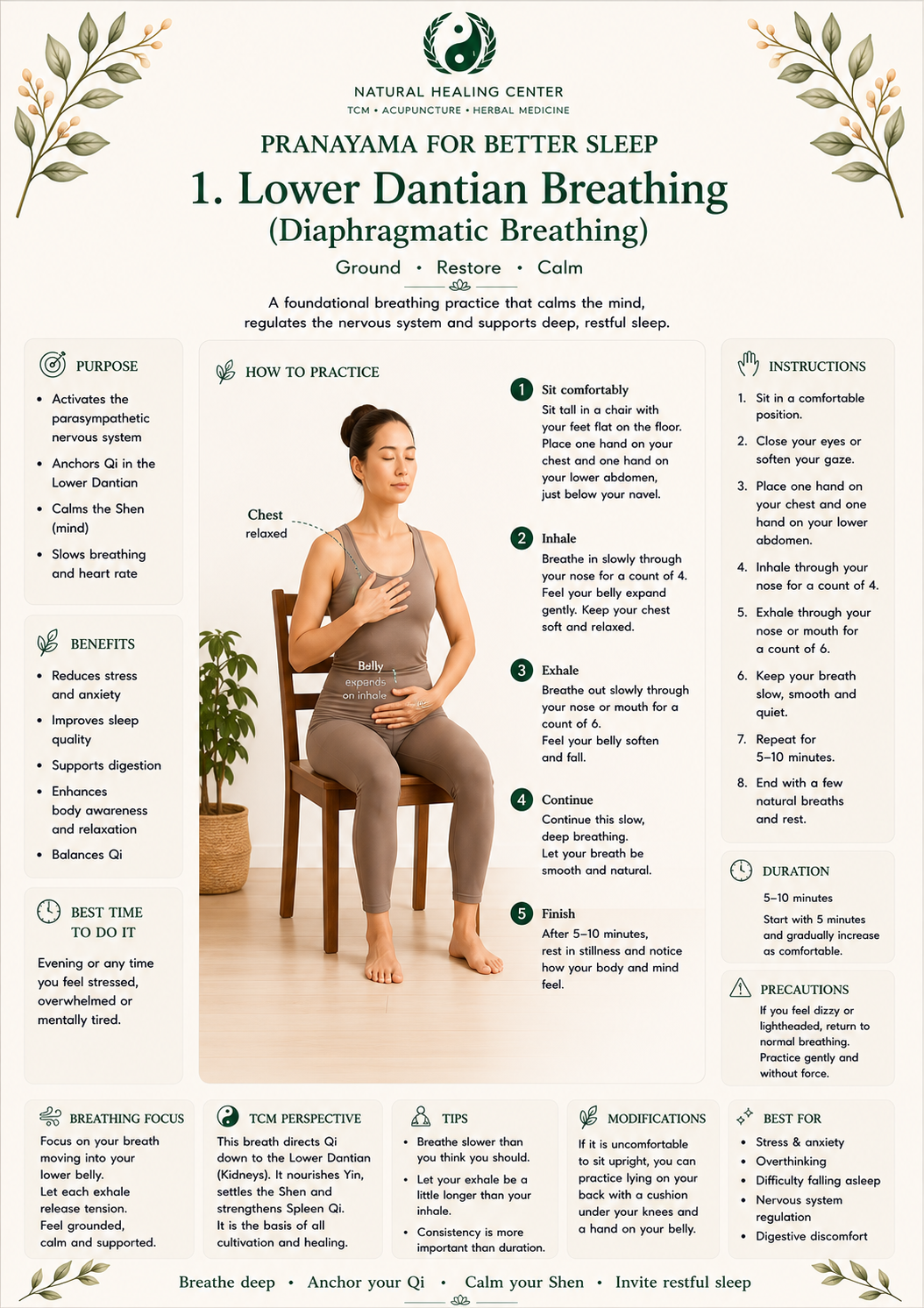
Slow breathing, gentle movement and focused attention may help create conditions associated with a calmer autonomic state.
That doesn't mean five minutes of Qi Gong magically eliminates stress.
It means that repeated periods of deliberate down-regulation may provide the body with opportunities to move out of constant activation.
This Is Why "Doing Less" Can Sometimes Be Therapeutic
We have become very good at telling exhausted people to do more.
Exercise more.
Work harder.
Become more productive.
Improve your diet.
Take another supplement.
Start another routine.
Optimise something else.
But sometimes the person sitting in front of me doesn't need another demanding task.
Their body needs an opportunity to recover.
That is one reason I like gentle Medical Qi Gong.
It doesn't necessarily require someone who is already exhausted to push themselves harder.
Sometimes the therapeutic intention is precisely the opposite.
Slow down.
Breathe.
Move gently.
Allow the nervous system to settle.
Can Qi Gong Help With Stress?
This is one of the better-studied areas of Qi Gong research.
Research into Qi Gong and related mind-body practices has investigated potential effects on areas including stress, anxiety, mood, sleep and quality of life.
Some reviews report promising findings.
However, there is an important qualification.
Qi Gong research varies considerably in quality.
Studies may use different forms of Qi Gong, different practice durations, different populations and relatively small participant numbers.
So it would be inappropriate to claim that Qi Gong has been proven to treat every stress-related condition.
The more reasonable conclusion is that Qi Gong is a promising low-impact mind-body practice, particularly in areas involving stress regulation and wellbeing, while research continues to develop.
What About Pain and Mobility?
Qi Gong can also involve:
gentle joint movement.
Weight shifting.
Postural control.
Balance.
Coordination.
Relaxation of unnecessary muscular tension.
Body awareness.
For someone who is stiff, sedentary or uncomfortable with vigorous exercise, this can make movement considerably more approachable.
And there is another important principle here:
Movement does not have to be aggressive to be useful.
Someone recovering from illness, living with chronic symptoms or experiencing significant fatigue may not tolerate the same physical demands as a healthy athlete.
The appropriate dose of movement matters.
What About Fatigue?
This requires some nuance.
When someone says:
"I have no energy,"
the instinct is often to stimulate them.
But chronic fatigue is not always simply a problem of needing stimulation.
Poor sleep, prolonged stress, inadequate nutrition, illness, pain, deconditioning and numerous medical conditions can contribute to fatigue.
Chinese Medicine also differentiates fatigue according to the person's broader pattern rather than assuming every exhausted person has the same problem.
Qi Gong may be useful because it can provide gentle activity without necessarily demanding high physical exertion.
For some people, ten minutes of calm movement may be much more realistic than a demanding workout.
And consistency can matter more than intensity.
Qi Gong Is Also Training Attention
There is another part of Qi Gong that is easy to overlook.
You have to pay attention.
Where are your shoulders?
Are you clenching your jaw?
Are you holding your breath?
Are your knees locked?
Is your abdomen tense?
Are you rushing the movement?
Can you feel your feet contacting the floor?
Many people move through their entire day without noticing how much tension they are carrying.
Qi Gong deliberately brings awareness back into the body.
This is sometimes described as interoception and body awareness in modern mind-body research.
Chinese Medicine describes the process differently, but again we find an interesting overlap between traditional practice and contemporary understanding.
Does Qi Gong "Move Qi"?
From a Traditional Chinese Medicine perspective, yes — that is one of its traditional purposes.
Movement, breathing and intention are used to encourage the appropriate regulation and circulation of Qi.
From a biomedical perspective, however, we cannot currently point to a laboratory measurement and say:
"That is Qi moving."
And I think it is important to be clear about that.
We don't need to pretend that traditional Chinese medical concepts and modern physiology are identical.
They developed in completely different medical traditions.
What we can study are measurable outcomes associated with the practice — such as changes in physical function, balance, stress, mood, sleep, pain, quality of life and physiological parameters.
That distinction allows us to respect traditional Chinese Medicine without making scientific claims that the evidence cannot support.
Medical Qi Gong Is Not About Performing Perfectly
This is particularly important for the way I use Qi Gong clinically.
You don't have to:
be flexible.
Wear special clothing.
Memorise complicated sequences.
Practise for an hour.
Be spiritual.
Or even understand Chinese Medicine.
For some people I may recommend only a few minutes.
One movement.
One breathing exercise.
Or a small sequence appropriate to what their body can currently tolerate.
The purpose isn't performance.
The purpose is regulation and consistency.
Why I Include Medical Qi Gong Within Chinese Medicine Care
Make it stand out
Whatever it is, the way you tell your story online can make all the difference.
Chinese Medicine has never been only about acupuncture or herbs.
Lifestyle has always mattered.
How someone:
sleeps.
eats.
moves.
breathes.
rests.
recovers.
responds to stress.
...can influence the overall clinical picture.
This is why I sometimes incorporate Medical Qi Gong into a broader Chinese Medicine programme.
It gives the patient something they can actively practise between consultations.
Not because Qi Gong replaces medical care.
And not because one exercise magically fixes a chronic condition.
But because recovery often happens through many small physiological inputs repeated consistently over time.
How Much Qi Gong Do You Need?
This surprises people.
You don't necessarily need an hour.
For someone who has done nothing previously, beginning with 5–10 minutes can be perfectly reasonable.
The objective is to establish something sustainable.
Five or ten minutes practised regularly may be more useful than an ambitious 60-minute routine that you abandon after three days.
Some people eventually enjoy longer practices.
Others continue using short sequences throughout the day.
There is no prize for doing the longest session.
When Qi Gong Should Not Replace Medical Assessment
Qi Gong can be a supportive health practice, but it is not a substitute for appropriate medical diagnosis or treatment.
New or unexplained symptoms — particularly significant weakness, fainting, chest pain, neurological symptoms, severe breathlessness, unexplained weight loss, persistent pain or other concerning changes — require appropriate medical assessment.
People with significant medical conditions, balance problems, recent surgery or substantial mobility limitations may also need their movements modified appropriately.
Gentle does not mean universally appropriate.
The practice should fit the person.
So, Does Qi Gong Really Do Anything?
Yes — although perhaps not in the magical way it is sometimes presented online.
Qi Gong combines several things that we already know can influence human physiology:
movement.
breathing.
attention.
relaxation.
postural control.
repetition.
And from the perspective of Traditional Chinese Medicine, those same practices are understood as ways of regulating Qi, supporting circulation, calming the Shen and helping restore balance.
You do not have to choose between believing every traditional explanation literally and dismissing an ancient practice entirely.
We can respect where Qi Gong came from while continuing to investigate how it affects the human body.
And perhaps its simplicity is part of its value.
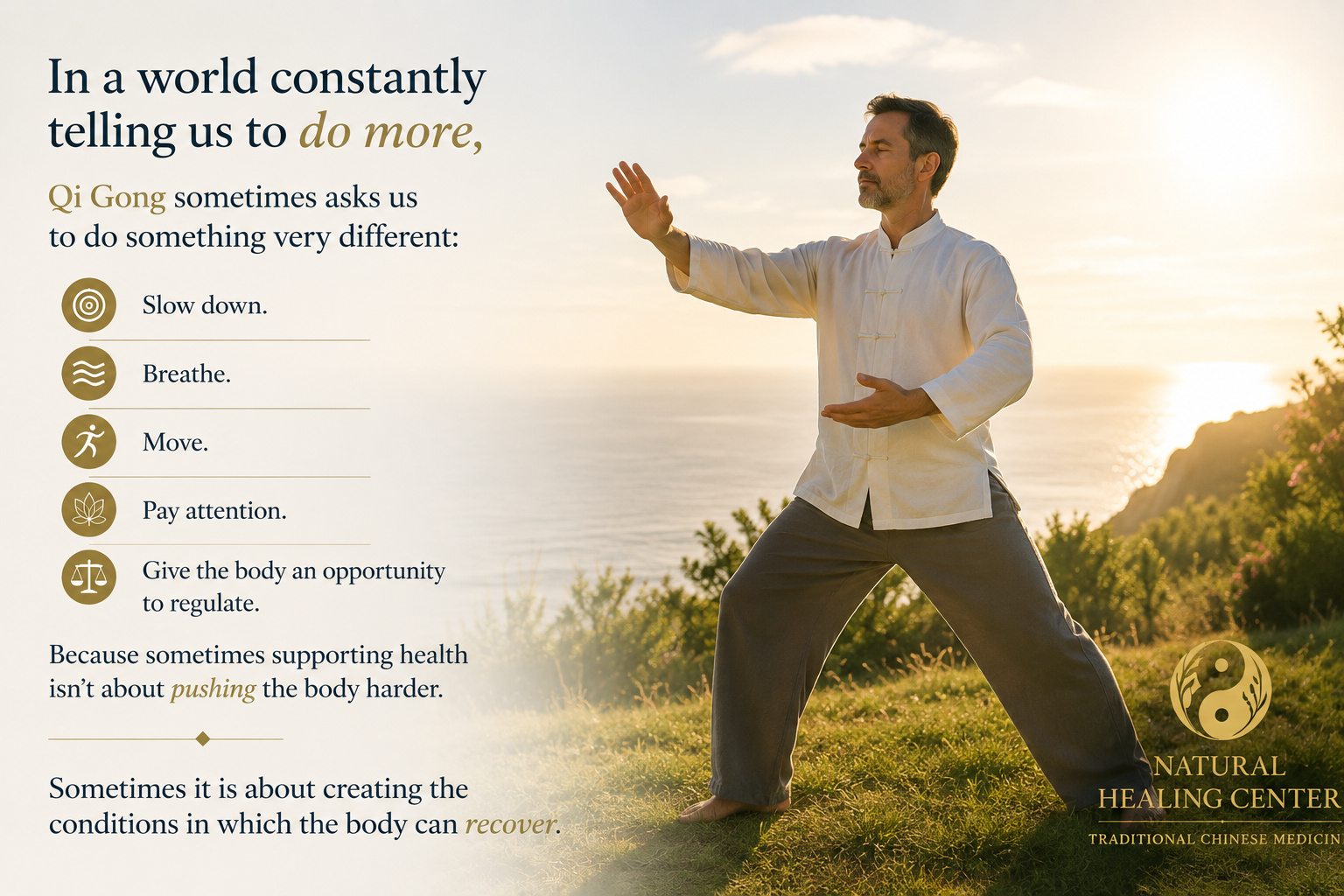
In a world constantly telling us to do more, Qi Gong sometimes asks us to do something very different:
Slow down.
Breathe.
Move.
Pay attention.
Give the body an opportunity to regulate.
Because sometimes supporting health isn't about pushing the body harder.
Sometimes it is about creating the conditions in which the body can recover.
Final Thought
The human body is constantly moving, transforming and exchanging energy.
Chinese Medicine developed its own language for understanding these dynamic processes thousands of years ago.
Modern physiology uses another.
They should not be treated as identical systems.
But both remind us of something important:
The body is not static.
It responds continually to movement, breath, stress, sleep, nourishment, environment and recovery.
Qi Gong brings several of those influences together in one remarkably simple practice.
And that may be why something that looks like "just slow movement and breathing" can be considerably more interesting than it first appears.
Natural Healing Center
Traditional Chinese Medicine • Medical Qi Gong • Herbal & Lifestyle Support

Make it stand out
Whatever it is, the way you tell your story online can make all the difference.