
Why Do I Feel Like There’s a Lump in My Throat? A Chinese Medicine Perspective
Have you ever felt as though there is something stuck in your throat — even though there doesn’t seem to be anything there?
You swallow.
You clear your throat.
You drink some water.
Perhaps you even find yourself repeatedly checking the sensation.
But it remains.
For some people, it feels like a lump. For others, it feels like tightness, pressure, constriction, mucus that will not clear, or simply the sensation that something is “there.”
Sometimes it becomes more noticeable during periods of stress or emotional strain. Sometimes it appears alongside digestive problems, chest tightness, frequent sighing or fatigue.
In Traditional Chinese Medicine (TCM), a particular pattern associated with this sensation has been recognised for centuries.
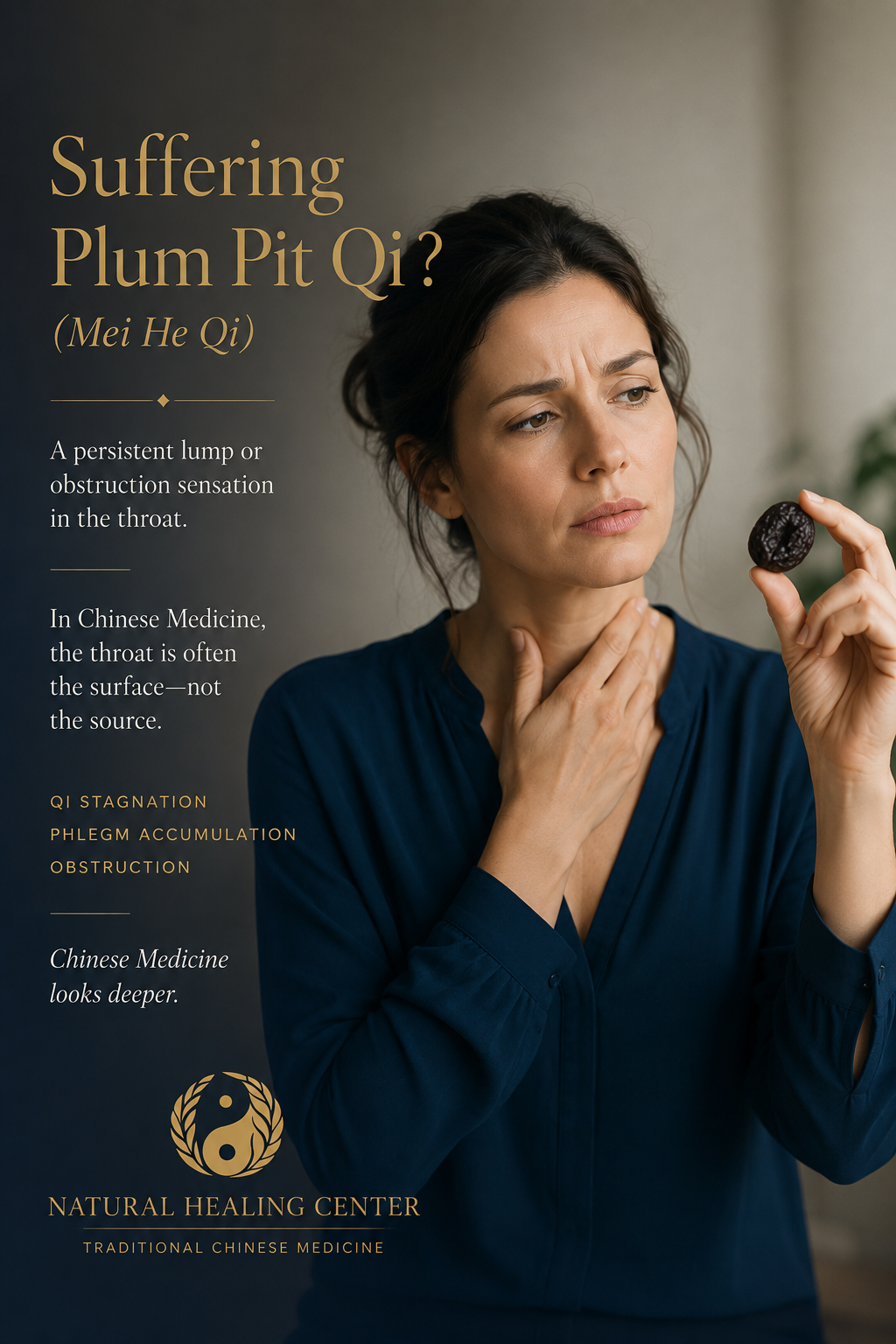
It is traditionally called Mei He Qi — often translated as “Plum Pit Qi.”
The interesting part is that Chinese Medicine does not necessarily consider the throat to be where the problem begins.
What Is Plum Pit Qi?
The classical description of Plum Pit Qi is the sensation of something lodged in the throat that cannot easily be swallowed down or cleared away.
People may describe it as:
a lump in the throat
something caught or stuck
pressure or constriction
a need to swallow repeatedly
frequent throat clearing
a sensation that comes and goes
symptoms that become more noticeable during stress
In modern medicine, a persistent sensation of a lump in the throat without an obvious physical obstruction may sometimes be described as globus sensation.
But from a Chinese Medicine perspective, the sensation itself is only the beginning of the investigation.
We want to know why it is happening.
Chinese Medicine Looks Beyond the Throat
One of the fundamental principles of Chinese Medicine is that symptoms rarely exist completely in isolation.
A throat symptom may therefore lead us to ask questions that initially seem unrelated.
How is your digestion?
Do you experience bloating?
Do you sigh frequently?
Does your chest sometimes feel tight?
Are you under significant stress?
Do you feel as though you are constantly holding tension?
Do you experience nausea or a feeling of fullness?
Are you fatigued?
Do you produce a lot of mucus or phlegm?
Does the sensation become worse when you are emotionally overwhelmed?
These additional signs help us understand the pattern underneath the symptom.
And with Plum Pit Qi, two concepts frequently become important:
Qi stagnation and Phlegm.
When Qi Stops Moving Freely

In Chinese Medicine, Qi describes, among other things, the functional activity and movement occurring throughout the body.
Qi should move freely.
Emotional pressure, prolonged stress, frustration, worry, exhaustion and other factors can interfere with this movement.
When Qi becomes constrained, a person may experience symptoms such as:
chest tightness
frequent sighing
abdominal tension
digestive disturbance
irritability
a feeling of being physically “stuck”
throat constriction
This is why someone can sometimes notice their throat becoming tighter during a stressful conversation, difficult period at work or emotionally demanding situation.
The sensation is physical.
That does not mean someone is imagining it.
Chinese Medicine has long recognised the relationship between emotional strain and physical function.
But Stress Is Not Always the Whole Story
It is easy to reduce Plum Pit Qi to:
Stress → throat tightness.
But the traditional pattern is more complex than that.
Another important part of the picture can be Phlegm.
When Chinese Medicine practitioners use the word Phlegm, we are not referring only to mucus that you cough up.
In TCM, Phlegm is a broader pathological concept associated with disturbances in the body's normal handling and movement of fluids.
This is where digestion becomes particularly important.
The Digestive Connection
In Traditional Chinese Medicine, the Spleen and Stomach systems are central to transforming food and fluids into the nourishment and energy the body needs.
When this process becomes weakened or disrupted, fluids may not be transformed and transported efficiently.
Over time, this may contribute to what Chinese Medicine describes as Dampness and Phlegm.
People with this broader pattern may also experience:
bloating
heaviness after eating
nausea
poor appetite
loose stools
sluggish digestion
mucus
brain fog
fatigue
a heavy feeling in the body
Now we begin to see why simply focusing on the throat can miss part of the picture.
If Qi is not moving freely and fluid metabolism is impaired, Chinese Medicine describes a situation in which Qi and Phlegm can combine to create a sensation of obstruction.
The throat may simply be where that obstruction is felt.
Qi Stagnation + Phlegm + Obstruction
This is the classical thinking behind many presentations of Plum Pit Qi.
You can think of it very simply:
Qi becomes constrained.
↓
The normal movement of fluids is affected.
↓
Phlegm accumulates.
↓
Qi and Phlegm obstruct one another.
↓
A sensation of something being stuck can develop.
This may be experienced in the throat, but other areas can be involved too.
Some people notice chest pressure.
Others experience digestive fullness.
Some sigh frequently.
Some feel nauseated.
Some notice symptoms primarily when stressed.
This is why two people who both say:
“I have a lump in my throat.”
may not necessarily receive the same Chinese Medicine treatment.
Why Stress Can Make It Worse
Many people notice a very clear relationship between their emotional state and their throat symptoms.
They may feel relatively well when relaxed but notice the sensation returning during periods of:
worry
frustration
grief
anxiety
emotional suppression
overwork
relationship difficulties
prolonged pressure
Chinese Medicine has always considered emotional health and physical health to be interconnected.
The Liver system, in particular, is associated with maintaining the smooth movement of Qi.
When emotional strain causes Qi to become constrained, this can affect other systems — including digestion.
This is one reason stress, digestion and throat symptoms may appear together.
But it is important not to assume that every throat sensation is caused by stress.
The complete clinical picture matters.
Plum Pit Qi Is a Pattern — Not a Diagnosis
This distinction is extremely important.
Plum Pit Qi is a traditional Chinese Medicine pattern description. It is not a biomedical diagnosis.
A sensation of a lump in the throat can have many possible causes.
New, persistent, unexplained or worsening throat symptoms should therefore be medically assessed, particularly when accompanied by symptoms such as:
genuine difficulty swallowing
painful swallowing
food becoming stuck
unexplained weight loss
persistent hoarseness or voice changes
a noticeable lump or swelling in the neck
bleeding
persistent or worsening pain
Chinese Medicine should not be used to assume that a structural or medical cause has been excluded.
Once appropriate medical assessment has been carried out, Chinese Medicine can then look at the person's broader presentation and determine whether a recognisable TCM pattern is present.
How Chinese Medicine Approaches Plum Pit Qi
Chinese Medicine does not simply ask:
“How do we get rid of the lump?”
Instead, we ask:
“What is creating the conditions for this sensation to occur?”
Depending upon the individual, treatment principles might include:
moving constrained Qi
regulating the Liver
supporting the Spleen and digestion
transforming Phlegm when appropriate
regulating the chest and throat
improving the movement of fluids
calming an overstimulated nervous system
nourishing underlying deficiency where present
Acupuncture, Chinese herbal medicine, nutrition, Medical Qi Gong and lifestyle changes may all form part of treatment depending upon the individual.
The treatment should address the pattern, rather than simply chasing the symptom.
What About Ban Xia Hou Po Tang?
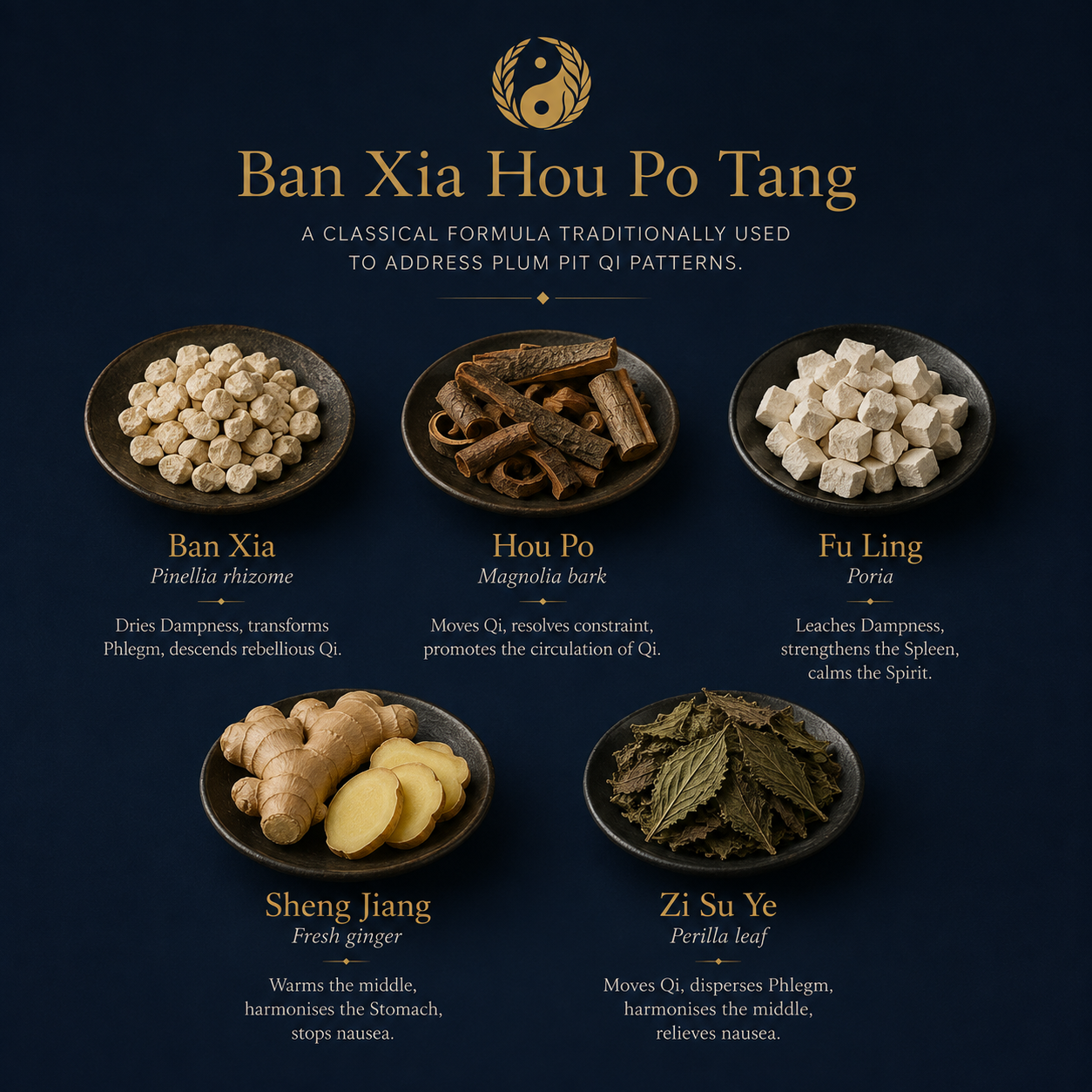
There is a classical Chinese herbal formula strongly associated with the traditional Plum Pit Qi presentation:
Ban Xia Hou Po Tang (半夏厚朴汤).
The formula originates from classical Chinese medical literature and is traditionally used for a particular pattern involving Qi constraint and Phlegm obstruction.
Its traditional ingredients include:
Ban Xia — Pinellia rhizome
Hou Po — Magnolia bark
Fu Ling — Poria
Sheng Jiang — Fresh ginger
Zi Su Ye — Perilla leaf
The herbs work together within the traditional formula strategy to regulate Qi, address Phlegm and relieve the sensation of obstruction.
However, this does not mean:
Lump in throat = Ban Xia Hou Po Tang.
That is not how Chinese herbal medicine should be practised.
Why Pattern Differentiation Matters
Someone may have a lump sensation associated predominantly with Qi stagnation and Phlegm.
Another person may have significant Heat.
Another may have pronounced Yin deficiency and dryness.
Another may have reflux or digestive dysfunction.
Another may have an underlying medical condition requiring conventional investigation.
And another may have a completely different Chinese Medicine pattern.
Using a classical formula simply because one symptom appears on a list risks missing the real clinical picture.
The tongue, pulse, digestion, sleep, emotional state, temperature, energy, bowel function, appetite and other symptoms all contribute to pattern differentiation.
This is why Chinese herbal formulas are traditionally selected according to the whole presentation, not one isolated symptom.
The Body Rarely Speaks in One Symptom
This is perhaps the most useful lesson Plum Pit Qi can teach us.
The throat may be what gets your attention.
But when we look more closely, we may discover a much broader pattern.
Perhaps your throat tightens when you are overwhelmed.
Your digestion has also become sluggish.
You are bloated after meals.
You sigh frequently.
Your chest sometimes feels restricted.
Your sleep is becoming lighter.
You are exhausted but continue pushing yourself.
Individually, these symptoms can seem unrelated.
Chinese Medicine asks whether there is a relationship between them.
That is why a detailed consultation involves much more than asking:
“Where does it hurt?”
We look at what is happening throughout the body.
Treat the Pattern, Not Just the Symptom
One of the central principles of Traditional Chinese Medicine is pattern differentiation.
Two people can have the same symptom for entirely different reasons.
And one underlying pattern can create several apparently unrelated symptoms.
That is why treatment should not simply suppress whatever symptom is currently making the most noise.
Instead, we try to understand the environment in which that symptom developed.
With Plum Pit Qi, the throat symptom attracts our attention.
The pattern explains why it is there.
And sometimes, understanding what is happening elsewhere in the body is the key to understanding the symptom that brought you through the door.
A Final Thought
If you regularly experience the sensation of something being stuck in your throat, particularly alongside stress, chest tightness, digestive problems, bloating, fatigue or frequent sighing, there may be more to the picture than the throat alone.
Traditional Chinese Medicine looks at these signs collectively rather than treating each one as an isolated problem.
The throat may be where you feel it.
But it may not be where the pattern begins.
This article is for educational purposes and describes Traditional Chinese Medicine theory. It is not intended to diagnose or replace medical assessment. Persistent, new or worsening throat or swallowing symptoms should be assessed by an appropriate healthcare professional. Chinese herbal medicine should be prescribed according to individual pattern differentiation and relevant medical history.